![[Staging: The Hiking Adventure]](https://staging.thehikingadventure.com/wp-content/uploads/2021/10/The-Hiking-Adventure-logo-high-res.png)
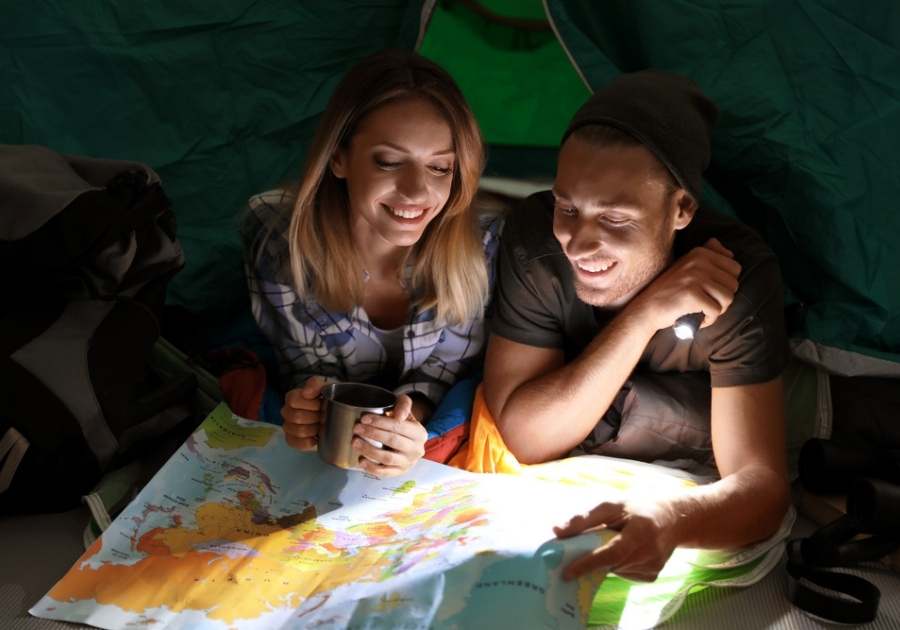
A good flashlight should be on the list of essentials that you pack for every trip. Even if you’re just planning on heading out for a few hours, you never know what might happen. Being able to find your way back in the dark or signaling for help is worth the extra few ounces you’ll be carrying.
If you’re doing multi-day trips then it’s definitely worth investing in the best backpacking flashlight for the money. As with anything that goes into your pack, you need to consider important factors like size, weight, and performance.
We’ve reviewed some great compact, lightweight options that still put out plenty of light. Fast foward to our buying advice on how to choose a flashlight.
Quick Recommendations:
- Best for Budget: OxyLed flashlight
- My Favorite: Olight Baton3 Premium Edition
- Customizable: VSSL Build Your Own Flashlight Survival Gear
Best Backpacking Flashlight: Reviews
OLIGHT Baton3 Premium Edition 1200 Lumens
At a Glance:
- Extremely portable and lightweight
- Very bright – 1200-lumen, 120-yard beam throw
- 0.5-lumen Moonlight mode – great nightlight
- Pocket clip direction allows for clipping on cap
- Anti-roll design
- 6 light settings
- Rechargeable, comes with aluminum-alloy case
- Flat magnetic tail cap is great for hands-free use
- IPX8 rated – very durable design
- 5-year warranty
- Can’t adjust beam focus
- No SOS mode
If you’re looking for one of the lightest and smallest flashlights, then the Olight will not disappoint. It’s only 2.48? long, 0.83? in diameter, and weighs just over 1 ounce. In spite of this tiny size, it puts out plenty of light.
On its highest setting, you’ll get an intense 1200-lumen beam. You can’t focus the beam, but the lens is set up to provide a good balance between close-up illumination while still throwing light up to 544 feet.
It’s powered by a single IMR16340 Rechargeable Battery (included) and charges by micro-USB which will give you 20 days on moonlight mode and up to 75 minutes on its highest setting.
You turn the torch on by pressing the low-profile silicon switch on the side. Using the same button to select between 4 brightness levels and a strobe mode. The Moonlight mode is a nice feature. At this level, it only puts out 0.5 lumens and works great as a nightlight.
Besides the high output and small form factor, the IPX8 rating and rugged design make this tiny flashlight perfect for backpacking.
VSSL Survival Light- Build Your Own Survival Gear
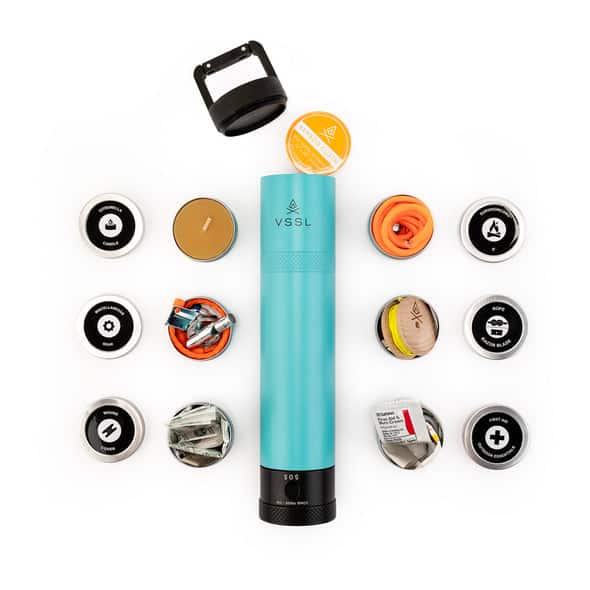
If you’re looking for a multi-purpose, ultralight, and small flashlight, then VSSL Camp designed their Build Your Own gear with you in mind.
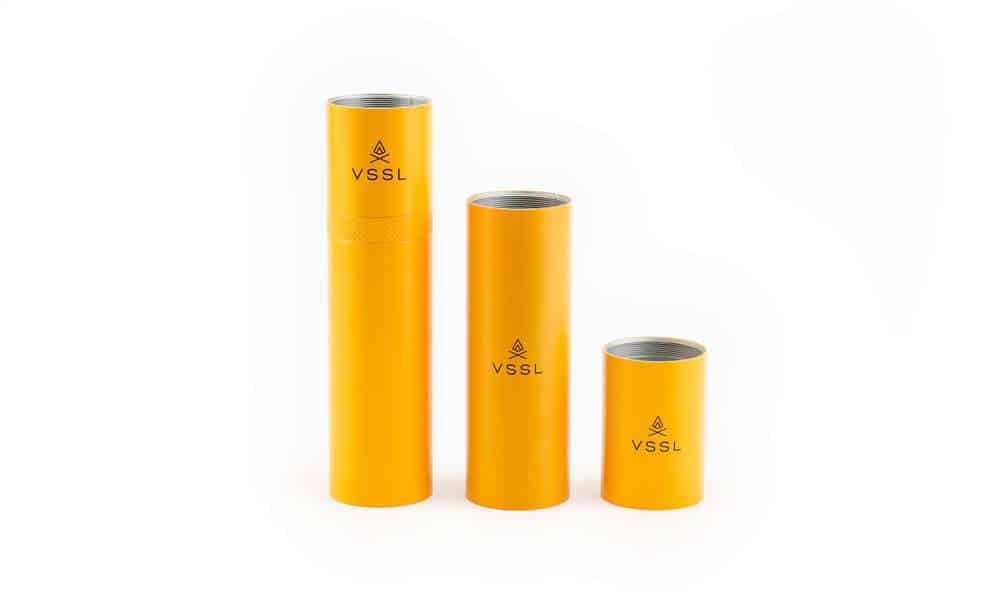
For the backpacker where every ounce counts along your backcountry journey, this VSSL survival light kit will be your dream. Why? Because of the many options to customize your vessel flashlight. Indeed, we counted 3 cylinder lengths, 22 end cap options, and 34 content choices.
First, starting with picking the casing or housing. Specifically, there are three different cylinder lengths, 2.75, 5.7, and 7.5 inches with a 2.0 diameter. Step one of the choose your adventure survival tube.
Next, select from one of 8 colors vessel flashlight choices. It’s easy to get hung up here, so be disciplined because you’ll need to choose an end cap.
Without a doubt, this is where your fun begins! VSSL survival canister has 22 end cap options, a few of which we included below, each one comes in several colors:
- compass
- carabiner end cap with compass
- flat top end cap
- carabiner end cap, no compass
Once you have selected the top, you get to pick the bottom end cap:
- 4-mode LED lantern
- flat top end cap
Perhaps the most difficult part, at this point, is to choose the tins that sit inside the survival canister. While it only has a 200 Lumens LED flashlight with 4 lighting modes: bright, dim, red, SOS, it’s decent for illuminating short distances.
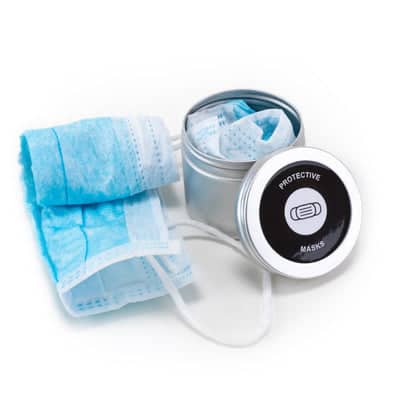
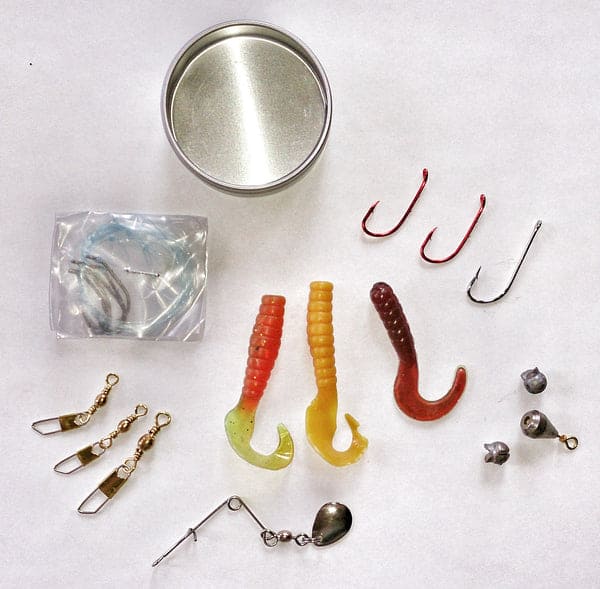
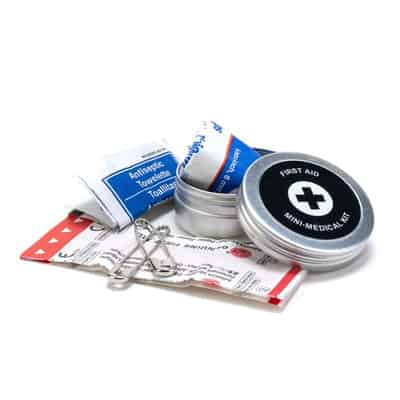
Here is when the true fun begins. You pick the tin contents, based on the casing length: drinking dice, beeswax candle, hunting ammo tin (bullets not included), first aid kit, forj tape, 8′ survival cord, Wire saw, fire starter, pyro putty, zip ties, face paint, adventure tape, gear repair , shotglass and more!
If you’re looking for a VSSL flask, this vessel doesn’t hold liquid, but then again, may help you survive in the wild.
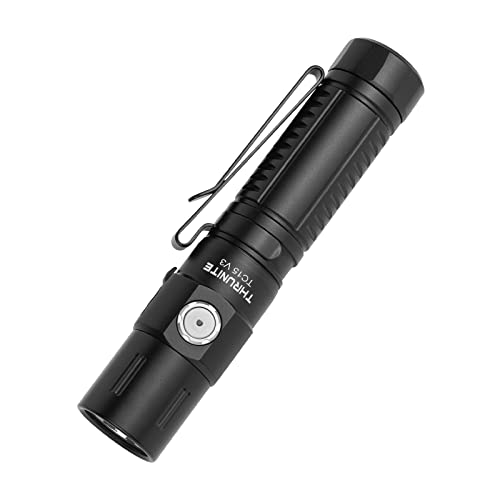
ThruNite TC15 2403 Lumens Flashlight, USB C Rechargeable LED Handheld Flashlight
At a Glance:
- Intense beam (223m) reaches up to 731 feet
- IPX-8 rated and 1.5m impact resistant – super durable
- Lightweight, compact design
- Firefly/ Low / Medium/ High / Turbo /Strobe light modes,
- Supplied with rechargeable IMR battery cell, the TC15 V3 features Built-In USB type C charging port
- Uses Cree XHP 35.2 LED – 20 years runtime
- 2-year warranty
- Mode selector button is a little shallow
If you’re in the habit of dropping stuff, then this sturdy flashlight is a good option. The rugged construction of this torch means you don’t need to be too careful with it. It’s IPX-8 rated and drop-tested to 1.5 meters so heavy rain and the usual bumps and drops aren’t going to kill it.
The button on the back turns it on and off; pressing the side button cycles through the different lighting modes. The mode selector button is a little shallow, but it’s a nice feature if you find the half-press button option that some flashlights use a little fiddly.
It has a memory function so when you switch it on it’s on the mode you previously selected. The compact design makes it great for slipping into your pocket or pack, and the knurled handle feels good in your hand.
The clip is a nice feature too, and it doubles as an anti-roll device so your torch stays right where you left it. At a max of 2403 lumens, it may not be as bright as some, but that’s still plenty of light for hiking.
In Turbo mode it throws an intense beam up to 721 feet. It comes supplied with an 18650 rechargeable battery that will give you around 5 hours on the High setting (200-lumens). The size, weight, rugged nature and quality construction make this a dependable best backpacking flashlight.
Maglite XL200 LED 3-Cell AAA Flashlight

At a Glance:
- Extremely light and compact design
- Easy brightness and light mode adjustment with memory
- Lockout feature prevents accidental operation
- Tactical pack comes with anti-roll device and pocket clip
- Uses standard AAA batteries (supplied)
- Made in the USA
- Only IPX4-rated water resistance
The quality of the LED’s, the optics and smart controls set the Maglite apart from the cheaper brands. It’s plenty bright enough for camping and if you’re looking to save on space and weight then you’ll be impressed by the small size (4.8’x1’x1?) and low weight (3.52oz).
You select the different lighting modes (On, night light, strobe, SOS) by multiple presses of the rear button. When you turn it off the flashlight will remember your last setting so you don’t need to cycle through them all again.
Pressing and holding the button and then rotating your wrist adjusts the strobe speed or brightness. It takes a little practice, but it’s quite an intuitive way to get the shine just right.
We liked the night light mode. In this mode, the output dims right down but as soon as you move the torch again it goes up to full brightness. This is great if you have to find it in the middle of the night.
The safety or lockout mode is a nice touch. It prevents accidental operation and draining of your batteries.
The beam distance is 450 feet at the batteries will last around 2.5 hours on full brightness. It uses standard AAA batteries, so they’re pretty cheap to replace.
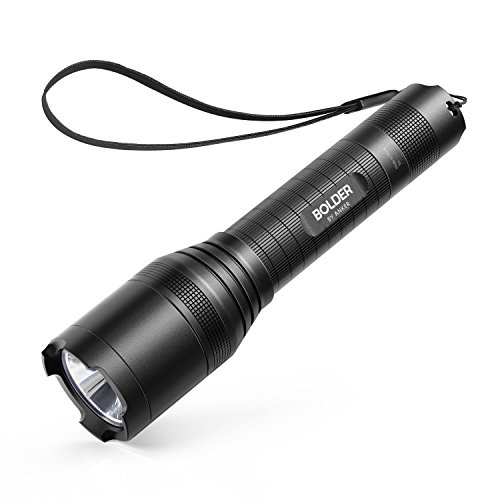
Anker Super Bright Tactical Flashlight
At a Glance:
- Extremely bright – adjustable up to max 900 lumen
- Zoomable beam reaches up to 660ft
- Included rechargeable batteries – last up to 6 hours
- Tough all-metal construction
- Only IP65-rated water resistant
- A little heavy at 6.2 ounces
If you’re looking for a mid-range flashlight that is super-bright and lasts for ages, then this one is hard to beat.
It uses a high-quality Cree LED to deliver and an adjustable brightness beam of up to 900 lumen. The all-metal construction is rock solid. It’s touted as a “tactical torch” so the handle and scalloped bezel are built for striking.
You’re not likely to come across any muggers on your trail but it’s nice to know that the torch will survive if you drop it. It’s only IP65 rated so you don’t want to go dropping this in water but it will survive just fine out in the rain.
The single button switch allows you to quickly select one of the 5 lighting modes: high-beam, medium-beam, low-beam, strobe, and emergency SOS.
The zoom adjustment slider changes the illumination pattern from a broad sweep to a focused beam that will reach around 600 feet.
We love that it comes supplied with a rechargeable battery which will give you 6 hours on medium and almost 2 hours on the brightest setting.
GearLight LED Tactical Flashlight 2 Pack
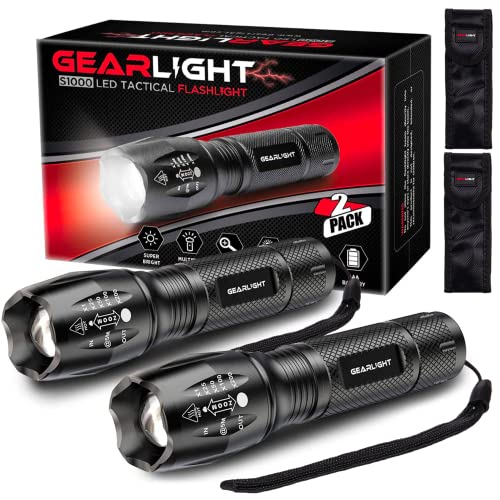
At a Glance:
- Super bright – 1000 lumen Cree LEd
- 5 light modes and fully zoomable
- Dimensions: 6.1 x 1.57 x 1.57 inches
- Tough construction – very durable
- Supplied with charger and rechargeable 18650 battery tubes
- IPX-6 rated – can use it in heavy rain
- Great price
- gets hot after a few minutes
- inconsistent brightness
If you want a good-value camping flashlight but still want decent light then this is a great option. In spite of the low price, you get a reliable model that is IPX-6 rated and uses a good quality Cree T6 LED.
GearLIght claima a max brightness of 1000-lumen and in practice the output is pretty close to that in their flashlight 2 pack.
You can choose to use 2xAAA batteries for use its rechargeable 18650 battery tubes. The flashlight can handle a 10-foot drop, ideal for those who are clumsy or fall from your backpack. Overall, you should get around 6 hours on the medium-brightness setting.
You select from the 5 standard light modes by a half-press of the power button on the back. It takes a little practice to get the finger pressure right.
The only problem is that it doesn’t remember the setting it was on. So you have to cycle through them again when you turn it on to select the lighting mode you want.
It’s a solid budget option, but you may want to bring some spare batteries along.
Our Favorite
We don’t much care about bragging rights when it comes to being able to light up a mountainside from a mile away. We want something small, bright and with decent battery life.
That’s why the Olight S1 Baton is our favorite. It’s a tiny flashlight with plenty of output and the rugged design means it’ll survive many a hike.
The quality construction, 5-year warranty, and smart design features make it worth spending a few extra bucks.
Best for Budget
The GearLight LED 2 pack flashlight is an excellent option if you’re looking to save a few dollars. While the battery life isn’t the greatest, it does offer some serious light output in a very durable housing.
It’s a great “just in case” torch if you’re not planning on doing a lot of overnight trips. It offers the usual multiple lighting modes, decent performance, and sound durability at a fraction of the price.
How to Choose the Best Flashlight for Camping & Backpacking
A flashlight is a pretty simple device. Right? Push-button, shine the light.
The kind of performance you get, especially while backpacking, is going to vary depending on a few essential factors. Here are a few things you should look out for:
Battery Life
How long your flashlight keeps shining depends on the kind and capacity of batteries you’re using and how efficiently it manages them. The battery life will also depend on how smart you are when using it. How can you keep the lights on for longer?
- Turn it down – Obviously, using the flashlight on maximum brightness will run the batteries down the fastest. Having multiple brightness settings gives you the option to extend the battery life by using a dimmer setting when you don’t need it to be super bright.
- More batteries – The more batteries you pack into a flashlight, the longer it’ll stay on. More batteries mean more weight and size, though. You might be better off buying a smaller flashlight and packing extra batteries.
- More battery capacity – Rechargeable batteries may have the same physical size but can have different capacities. Choosing a higher capacity battery, and remembering to charge it fully, will keep your torch shining for longer.
What kind of battery should I use in my flashlight?
When choosing a battery type you need to consider cost, weight, size, energy density and environmental factors. The kind of battery will also have an impact on how much of the potential brightness you’ll be able to get.
- Disposable alkaline – Cheap and readily available. The lower energy density means they won’t pack enough punch to get maximum brightness from your LED torch and they don’t last as long as Lithium batteries. Being disposable there’s an environmental aspect to consider too.
- Rechargeable alkaline – Cheaper rechargeable option but will typically only accept a few charges before failing.
- Lithium – Excellent energy density means more power with less weight. A Lithium powered flashlight will give you the brightest output and longest runtime. Make sure you buy rechargeable lithium batteries and not disposable ones.
- NiMH (rechargeable) – Expensive upfront cost but saves you money over time. You’ll get a few hundred charge cycles, but the energy density will drop around 10%-15% after the first hundred charges.
If you want the best performance from your flashlight then go for one powered by a rechargeable Lithium battery. It’ll give you the brightest output and the longest battery life.
Flashlight Durability & Impact Resistance
The durability of your flashlight comes down to how it feels about you dropping it or getting it wet.
Impact resistance – Some flashlights will specify a height that they’ve been drop-tested to. While these are hard to quantify, at least when you see this you get the idea that they’ve designed it to handle a few knocks. If you see one described as “tactical”, it means they’ve developed the housing to be able to bash stuff. You may not intend using it in a defense scenario but a tactical flashlight will generally have good impact-resistance.
Waterproof rating (IPX rating) – The IPX rating gives you an idea of how water resistant it will be. The higher the number, the more resistant it is to water.
- IPX4 – Will be fine in light rain but won’t handle being submerged.
- IPX5 – IPX6 – Will survive heavy rain but can’t be submerged.
- IPX7 – Can be submerged in water of up to 1m.
- IPX8 – Can be submerged in more than 1m
Having an IPX8 rated flashlight sounds cool but are you likely to drop it in some deep water? Is it worth spending more money to get°For most backpacking conditions you’re probably okay with something in the IPX4 – IPX6 range.
Flashlight Size and Weight Considerations
As backpackers, we tend to look for the lightest and smallest versions of our gear. You do get some tiny flashlights but the smaller they go, the more sacrifices you make. Smaller means less battery, less hand grip, and less light output.
The very small ones will also generally have fixed focus lenses so you won’t be able to adjust from a wide to a narrow beam. A more ruggedly-constructed flashlight may be heavier but it’s also more likely to survive you dropping it a few times.
The housing material will also have an impact on the weight. One made from titanium will be a lot lighter (and more expensive) than a cheaper stainless steel one.
Flashlight Light Output – How Bright Is Bright Enough?
Rechargeable Lithium batteries will power the brightest lights. Even some of the more compact of these torches can put out 800 to 900 lumens.
Flashlights powered by AA alkaline batteries will top out at around 500 lumens. But even that is still pretty bright. It all depends on how much light you need.
The brightness of the LED is only part of the equation. How that light is concentrated – or focused – determines the overall illumination you get.
Beam distance (Throw)
Different LED’s will have different beam patterns. Some are designed deliver the light output at a wider angle. These will flood an area but will have a shorter throw, or depth.
Other LED’s will have a more focused, narrower beam that doesn’t illuminate a wide area but penetrates a lot deeper into the darkness ahead of you.
A best backpacking flashlight with a high powered LED coupled with adjustable optics will allow you to vary the focus to suit your needs.
When a manufacturer says their model has a beam throw of 300 feet they’re saying that the light 300 feet away from the torch will be at a brightness similar to the light of a full moon.
How Do We Measure Light Output?
When comparing flashlight brightness, most manufacturers will quote a figure in Lumens.
Lumens essentially refers to light output and is a measure of how bright the light coming out of the flashlight appears to be.
When using this figure, it gives you a basic comparison tool when deciding which model is brighter. A higher number, in simplistic terms, means a brighter flashlight.
The angle of the beam and color of the light will also have a significant effect on how useful that light is at offering decent illumination.
Some manufacturers will also quote a Lux figure. This gives you an idea of the illumination of a 1 square meter area at a certain distance. It’s used less often when comparing flashlights.
Candela, or candlepower, gives you an idea of how far away you can be and still see the light. A more intense, focused light will have a high candela rating but it tells you very little about its ability to illuminate an area.
Flashlight Bulb Type
It used to be that all flashlights used incandescent bulbs. These were inefficient and not particularly bright for their size either.
If you want intense light from a small battery, then an LED bulb is the only way to go. They’re also a lot less likely to break if you drop them.
Runtime
Sure that flashlight is bright now, but for how long? The runtime that manufacturers quote is a measure of how long it takes to go from maximum brightness to 10% of that output.
Naturally, if you’re using the brightest light your flashlight can deliver, you’re going to get the shortest runtime.
The kind of batteries you’re using as well as the ambient temperature will affect the amount of runtime.
Beam Type
- Spot – Some flashlights will have a narrow, focused beam. These work well for seeing far into the distance when plotting your route but won’t illuminate much to the left and right of you.
- Flood – A broader beam for illuminating a more extensive area but with a shorter throw, or penetration.
Ideally, you want the best of both worlds so look for the best backpacking flashlight with an adjustable focus.
Modes
Having multiple modes gives you control over your battery life (runtime) as well as some other useful features. Typically backpacking flashlights come with the following:
- High – Maximum brightness
- Mid – Normally around a third to a half of the maximum brightness.
- Nightlight / Moonlight – The flashlight is barely on but is great as a nightlight and handy when you’re trying to find it in the dark.
- Strobe – Normally a feature in tactical flashlights. Intended to disorient an attacker or for signaling.
- SOS – Some flashlights can continuously signal the dots and dashes of the Morse SOS signal.
Controls
Most of the compact flashlights have an on / off press button on the base or tail cap. In addition to turning it on, some will rely on a half-press or multiple presses to select different modes.
Others will use an additional side button for mode selection. Some of the really smart ones, like the Maglite XL200, use the rotation of your wrist to adjust the brightness.
It’s worth spending a little more to get a flashlight that has a memory function. This means that once you select a mode and then switch it off it will start up in that mode again when you turn it on.
Flashlight vs. Headlamp
While we’ve focused on flashlights in this post, some people do prefer using a headlamp. Which is better? It depends on what you’ll be using it for and your personal preference. The obvious benefit of a headlamp is that you get to use it hands-free.
They’re also light and portable so they’re easy to stash in your pack.
The problem with a headlamp is that you need to turn your head wherever you want to shine it. Also, the battery life and brightness of the LED lights don’t come close to what you get in a good flashlight.
If you want great performance and hands-free operation then get a small flashlight with a clip so you can attach it to a baseball cap when you need both hands.
What do you prefer? Flashlight or headlamp? Tell us what your favorite flashlight is and why, we’d love to hear your opinions.
Need More Advice on Gear and Footwear?
Here are some links to our most popular articles:
- 15 BEST SOLAR CAMPING LIGHTS
- 11 BEST PORTABLE SOLAR CHARGERS FOR CHARGING IN THE WILD
- Essential Hiking Gear for Women
- BEST PORTABLE POWER: BATTERY PACKS & SOLAR CHARGERS
- Best Water Filter and Purifier for Backpacking and How to Choose
- JETBOIL ZIP VS FLASH: BATTLE OF THE BOILERS
- BEST ENERGY BARS FOR HIKING TO KEEP HUNGER AT BAY
- Insider Secrets of Backpacking Meal Planning
- BEST UNDERWEAR FOR HIKING: MEN’S AND WOMEN’S
Join our Facebook Group – Outdoor Gear Reviews, Deals, Hacks & Advice- Backpacking, Hiking & Camping to get the latest reviews, deals, and discounts on backpacking, camping, and hiking gear. Share tips, and advice and to show our love, we also give monthly gear giveaways.

Last update on 2022-12-23 / Affiliate links / Images from Amazon Product Advertising API